Judge Says Russia Software Company Can Be Tried

'A federal judge on Wednesday denied final motions to dismiss a lawsuit against a Russian software company accused of violating a controversial U.S. copyright law that defense lawyers argued is unconstitutional....

'``The DMCA does not eliminate fair use or substantially impair the fair use rights of anyone,'' the judge wrote in a 35-page opinion. ``The fair user may find it more difficult to engage in certain fair uses with regard to electronic books, but nevertheless, fair use is still available.'''

Nice versus Good

The premise of this piece [on overly-"nice" men] is born out in blogland. [Scripting News]

I'm not convinced this issue has much to do with sex in general, except inasmuch as it tends to wander back and forth amoungst the sexes over time. But I do believe the issue is importent. I tend to think of the issue as "Nice" versus "Good".

Nice is a pale reflection of Good, with the rough edges filed off and all the hard parts taken out. Being nice involves a lot of lying, white and otherwise. Nice means not just allowing yourself to be bullied, but allowing others to be bullied, because "it's not nice to stick your nose where it doesn't belong". (That's a statement so vague it's only true or false (or in between!) in a specific context!)

Spring!

Spring is here, and I'm enjoying it. Generally I'm a stereotypical pasty computer nerd, but after an especially frustrating semester at school (frustrating... not hard, frustrating), I actually voluntarily did some garden work today, a first I think. Wierd!

The sun is bright, the birds are chirping, and if anything, I think these silly emails have added a measure of levity to my day. Meanwhile, I'm posting this from my porch via a long ethernet cable (ahh! wireless!) and getting ready to grill dinner. Carpe the spring diems!

Quantum Encryption

Discover Vol. 23 No. 5 (May 2002) Future Tech: Hack-Proof Chatting. The race is on to make unbreakable codes by tapping into the oddities of quantum physics... [Privacy Digest]

I wanted to comment on this, since I feel I'm in an unusually good position to understand it.

First, the claims are quite real, and quite attainable. This setup really can ensure that nobody can eavesdrop on your conversation without your knowlege, at least in the middle of transmission. Of course, as soon as you detect anyone eavesdropping, you stop transmitting, leaving the interceptor with only a few bytes (ideally) of data. Combined with conventional encryption, that data is virtually worthless.

Breathing room - in fact, a bit too much

As the recent run of posts on my weblog might lead you to believe, I've had a little more time lately then the last couple of weeks. The downside of working with a partner on a project is that you feel morally obligated to give it 110% for his sake, even if you're inclined to just do enough to get by. . . or even if you've made it to 100% already and you want to stop for a bit. But it went well, and I think we gave the best presentation of the class. (It is surprisingly difficult to give a 30-minute presentation. Nearly everybody tried to give a 60-minute presentation, and lopped the last half off. I think we were the only group to finish in 29 minutes, only chopping off a couple of slides I put in as sacrificial cows in case I had underestimated the time.)

Paul Snively Replies

Paul Snively replies to yesterday's exploratory post regarding RPC vs. REST. I'd say I feel confident that the issues are explored.

I'd say the best thing REST advocates can do is make the tools as simple to use as the approx. 100 implementations of XML-RPC and SOAP. The URI part of the argument, with the corresponding issues, does make sense, and all things considered, I would side with the REST side of issue.

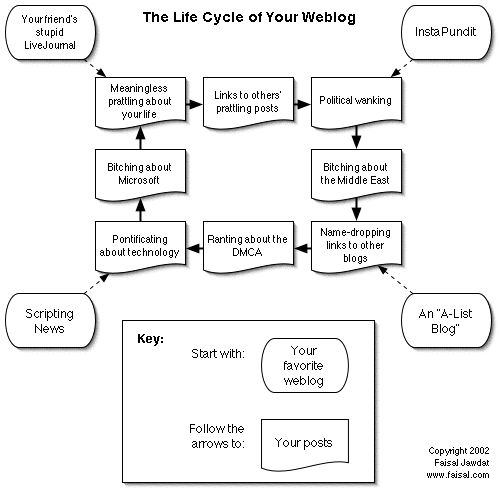
Weblog Life Cycle shows iRights is sick. . .

I'd like to thank faisel.com for the weblog life cycle key; it's revealed to me that iRights is dangerously sick! I don't know how rapidly a weblog should be going around that loop, but I've been stuck on "Ranting about the DMCA" for over two years now! That can't be good.

I'll try hard to get to "Pontificating about technology" here as soon as possible; I know you dear readers are depending on me. . . probably been wondering what's taking me so long... my deepest apologies!

REST vs. RPC exploration

This is a technical post regarding something approaching a technical Holy War; if you're here for the internet stuff, please ignore the following.

Paul (Snively) says, This is the part I find baffling: someone as smart as Roland finds REST "harder to understand" than RPC! I'd be very interested—no sarcasm, as Dave would say—in hearing some comments about that, as I want to gain a better understanding of the issues so that my own ignorance doesn't become self-defeating in RPC and REST discussions. (Check the context if you're really interested in following this.) I had been conversing a bit in his comments, but I wanted to get this more out in the open.

CIA Warns of Chinese Plans for Cyber-Attacks on U.S.

LA Times - Analysts fear government and private efforts to sabotage federal Internet sites. [Privacy Digest]

Believe it when you see it. The press is throwing cyber war warnings everywhere it can. . . most of them are quite unimportent. These threats always come to effectively nothing, even when the CIA or FBI issues them.

Remember, if it was that easy, it would be happening. It is that easy, and it is happening. Every day. Most of us don't notice. Sometimes a site we care about gets hacked; the backup tapes roll, the patches are applied, and life goes on. Threats of escalation are mostly empty posturing.