Bar association may oppose UCITA
UCITA
6/14/2001; 6:38:26 PM 'The American Bar Association may vote at its annual meeting in August to oppose UCITA unless the controversial software licensing law is extensively revised.
'The ABA's Tort and Insurance Practice Section, a major group within the Washington-based organization, stated in a recent resolution obtained by Computerworld that UCITA should be "extensively revised" to more adequately reflect current law on licensing intellectual property, "with due regard for basic rights of consumers and the protection of licensees from unwarranted unilateral actions of the licensor." This language is included in a resolution that may be considered by the ABA's approximately 530-member House of Delegates, its national legislative body.'
U.S. judge to hear Yahoo! case of French Nazi ban Country Watch: France6/13/2001; 12:30:48 PM 'In a case with broad implications for free speech on the Internet, a U.S. federal judge has agreed to consider whether foreign courts may determine what Yahoo! Inc. sells on its auction site, a company spokesman said on Friday....'U.S. District Court Judge Jeremy Fogel in San Jose on Thursday rejected a French request to throw out Yahoo!'s challenge to a French court order last year which sought to block Yahoo's auctions of Nazi items under broad French anti-hate speech laws.'Yahoo!'s objection is that France actually required Yahoo! to comply with French laws worldwide, thus they had to remove all Nazi materials from all Yahoo! sites, even those not in France. Contrast this with the previous news story...
Harm from the Hague Misc.6/12/2001; 8:20:50 PM 'The Hague treaty is not actually about patents, or about copyrights, or about censorship, but it affects all of them. It is a treaty about jurisdiction, and how one country should treat the court decisions of another country. The basic idea is reasonable enough: If someone hits your car in France or breaks a contract with your French company, you can sue him in France, then bring the judgment to a court in whichever country he lives in (or has assets in) for enforcement.'The intersection of all activities not banned by patent, copyright, and censorship restrictions somewhere in the world is effectively a null set. It is not reasonable to assume that this tidbit of knowlege, obvious even to a computer nerd, has somehow consistently escaped the treaty writers. Thus, one must search for the motivation behind this treaty, because on the face of it, the whole idea is incredibly stupid and naive.Only two motivations seem to be in the running: Money (corporate interests) and power. Money does not seem likely to me; any company interested in using this to their advantage is just as likely to find themselves on the wrong end of a lawsuit in Nigeria or Egypt or Hong Kong or who knows where (perhaps "The Country That Always Finds In Favor Of The Prosecution, For A Small Price", recently formed off the coast of, oh, let's say France?). Then again, corporate interests are notoriously short-sighted... perhaps this is yet another example of a purchased law that will inevitable come back to haunt the purchasers.Still, I feel the only viable conclusion is that this treaty must be a power play by somebody, as it is equally obvious even to a computer nerd that all the courts in the world working 24 hours a day could not possibly service all the possible suits that could be filed should this go through. 100% enforcement is clearly not the intention. The whole point is going to be selective enforcement, which directly translates to power in the hands of whoever is doing the enforcing. (That's a powerful argument against proliferating laws, BTW; the power of selective enforcement tends to fly under the radar and remains undetected until it's in strafing range, but it's a very real power nonetheless.)Still, I can't think of a party that doesn't stand to lose as much as they might gain. Perhaps somebody can answer this for me: Who truly gains from this? The only answer I can think of is "the Third World" (giving them extensive powers over the courts of the rest of the world, notably the First World), but that's a vague answer and still doesn't explain why anybody else would sign this thing... who gains?(A truly paranoid answer: Only those countries with the maximal restrictions on speech, patents, or copyrights. For instance, Afghanistan. Afghanistan would be able to propogate its control far and wide. So, the people pushing for support of this treaty are those who want this control propogated, and are using this as a door to turn otherwise free countries into effective dictatorships in certain areas. It's paranoid, of course... but the thought has certainly crossed more then one mind.)
Microsoft Tries To Get Smart Humor/Amusing6/11/2001; 7:40:10 PM 'Microsoft bashers were out in full-force last week, chastising the company for a new technology in the forthcoming version of its Windows operating system they say infringes on free speech, intellectual property and the copyrights of Web content creators.'What's it all about? Microsoft is considering adding a feature to Windows XP (link to Microsoft XP order info page), due out Oct. 25, that would take users to links predetermined by Microsoft (link to favorable article about Microsoft).'Few situations call for the injection of humor more then a ferocious debate about a proposed feature for an unreleased operating system that may or may not affect rights that we may or may not have.
Law Review Article Says Port Scanning Illegal Misc.6/11/2001; 9:13:23 AM From Slashdot:
Anonymous Coward writes: "The Journal of Technology Law and Policy has a good article on computer security and privacy.... It's interesting to see the computer security from a lawyer's point of view. Especially interesting are his claims that using nmap is illegal, despite the VC3 v. Moulton case...." Actually, I think the metaphors throughout this piece (not just at the beginning) are what make it interesting, and a big component of law is dealing with metaphors.You probably know how I feel about those treacherous metaphors: Useful for exaplaining, useless for determining. You might also want to look at my explanation of port scanning, if you've never heard of it before. I couldn't find a satisfactory explanation on the net so I wrote my own.
Two Heads Up Administrative6/8/2001; 1:48:42 PM Alright, two heads up:1. The previous re-design was not intended to last as long as it has. I will be taking another go at it, and hopefully it will improve the site significantly.Update: I'm not quite done and I need to go do some other stuff, but this ought to be an improvement. Still not happy...2. The winds of change are blowing. I'm not ready yet, and it may not be for a month or two, but this site is slowly packing up and preparing to move to my own webspace. So get ready for an improved experience.If you run a freely-hosted Userland site, I think you should check out the Manila Site Converter tool for RU, even if you don't intend to immediately use it.
Washington Spam Law Upheld
Spam & E-Mail
6/7/2001; 7:23:44 PM 'An anonymous submitter sent in news that the Washington state Supreme Court upheld Washington's anti-spam law today. The law requires truthful information on all commercial emails sent from Washington state or to a Washington resident - commercial emailers may not disguise the origin of their messages (but aren't prohibited from sending UCE if they don't try to disguise themselves).... The decision is interesting, because several state internet censorship laws have been struck down due to their effects on residents of other states - it's worth reading for anyone interested in internet legal issues.'
Where's Dangerousmeta?
Personal Notes
6/7/2001; 1:29:08 PM I've been trying to get through to Dangerousmeta now for a week or so, but can't. Is the site down, the DNS down, or is the problem on my end?
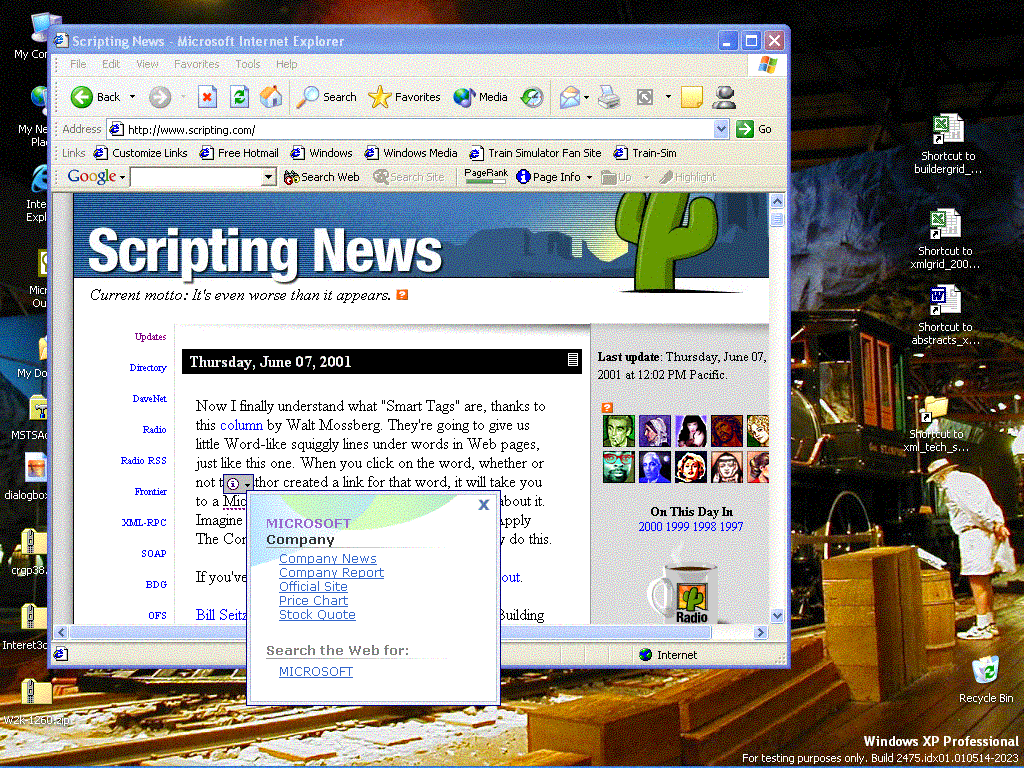
New Windows XP Feature Can Re-Edit Others' Sites Website Annotation6/7/2001; 9:35:46 AM 'I've already encountered one proposed feature, in a "beta," or test, version, that shows Microsoft may well flunk both these tests. The feature, which hasn't yet been made public, allows Microsoft's Internet Explorer Web browser -- included in Windows XP -- to turn any word on any Web site into a link to Microsoft's own Web sites and services, or to any other sites Microsoft favors.''In effect, Microsoft will be able, through the browser, to re-edit anybody's site, without the owner's knowledge or permission, in a way that tempts users to leave and go to a Microsoft-chosen site -- whether or not that site offers better information.'No bad idea ever dies in the computer industry, it just gets picked up by Microsoft. Perhaps now that it's Microsoft modifying other's sites, we'll get some better debate on the issue. Normally I dislike the "Microsoft is automatically wrong!" people, but perhaps for once this will actually improve the debate: If this is released, the (IMHO extremely shortshighted anyway) argument that very few people do this will disappear. This does finally provide a functional and real demonstration of the real harm that Website Annotation can do, including real financial harm: Non-Microsoft "approved" vendors may have links to Microsoft-approved vendors, but Microsoft approved vendors will not have that disadvantage. This can cost customers and $$$.To Wes and the other supporters of annotation, this is the real and again present danger. There is no real difference between this and CritLink or Third Voice or Flyswat. Once changing the contents of other sites in this systematic fashion is OK, whether its "perceived" contents or "real" contents doesn't much matter right now, then you've lost all reasonable guarentees that your message is getting through to your site-readers.Even this simple change can have very real consequences to a site's message. Consider how the NoAmazon.com site might look through this feature... it's a good guess Amazon will be one of the featured services (they need the help), so now NoAmazon.com is plastered with links to Amazon whereever they mention Amazon (frequently), or products Amazon sells (look in the sidebar). Joy! Yes, that's maintaining the integrity of the site.Moreover, by putting this power in the hands of anybody who has the technical ability to pull this off, we are putting immense amounts of power in the hands of Microsoft. Once you open the page-modification door, all manner of things become possible. For instance, this is equivalent to giving Microsoft the power to censor, a power I don't want anyone to have. If they don't like something, they can change it, even if only by the subtle means of creating links that lead to Microsoft-approved propoganda pages.There's more to smart-tag technology then this, most of it inoffensive and perhaps even "innovative" (for Microsoft definitions of the term "innovative"), and this particular debatable part of it may be removed due to public outcry. But it's still important to have the debate.Update: Image of smart tags at work, DaveNet on SmartTags.
Code-Breakers Go to Court
DMCA
6/6/2001; 5:59:58 PM 'On Wednesday, Ed Felten of Princeton University and seven other researchers took their fight to a New Jersey federal court in a lawsuit asking that they be permitted to disclose their work at a security conference this summer....'
"When scientists are intimidated from publishing their work, there is a clear First Amendment problem," says EFF legal director Cindy Cohn. "We have long argued that unless properly limited, the anti-distribution provisions of the DMCA would interfere with science. Now they plainly have."'